

Education, Understanding and Reconciliation: A Trip to the Woodland Cultural Centre and Mohawk Institute, Brantford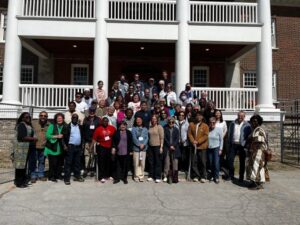
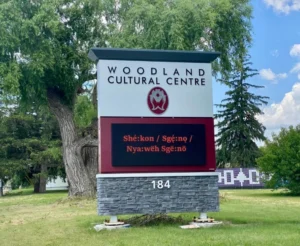
On September 8th, David and Mary Dillon joined members of the Tri-Regions of Antler River Watershed, Horseshoe Falls, and Western Ontario Waterways for guided tours of the Woodland Cultural Centre and the former Residential School known as the Mohawk Institute in Brantford. The Centre and Institute are located on approximately 40 acres of Reserve Land situated within the City of Brantford. Also on this land is the Mohawk Chapel. Built in 1785, it was the first Protestant Church in Upper Canada and is now the oldest church in Ontario.
The tour of the Woodland Cultural Centre was very interesting. Our knowledgeable tour guide and the beautiful Indigenous artwork helped to tell the history of the area. The Six Nations of the Grand River is the only First Nation community that includes all six Haudenosaunee nations: Seneca, Cayuga, Onondaga, Oneida, Mohawk, and Tuscarora. Established in 1972, upon the closure of the Mohawk Institute Residential School, the Centre is one of the largest facilities in Canada managed and administered by First Nations, and serves to promote and strengthen Indigenous language, culture, art and history.
The Mohawk Institute is the longest-running and largest Indian Residential School in Canada. Research indicates that 4,581 children attended the school during its 139 years of operation. It is estimated that 1 in 10 children who attended an Indian Residential School in Canada attended the Mohawk Institute. The Institute closed in 1971. There are records of 97 children dying while at the Residential School but this number may be higher as many students managed to escape, some never being heard from again.
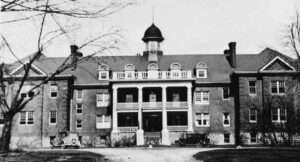 This former Residential School was preserved to look the way in did during the years it had Indigenous children living, learning and working there. It was a powerful experience to walk down the hallways and through the various rooms, for the energy still exists there. Each room – and there were many, including the school room, dining hall, kitchen, boiler room, isolation room (5’ x 4’ x 6’ tall with only a board the size of a single bed and a bucket for their toilet), boys’ and girls’ toy rooms and gender-specific dormitories. Each room, as well as some items and pictures within, were numbered and participants could hear the related story by pressing the appropriate number on the electronic gadget they were given. It was eye-opening and heart-wrenching to experience the stories (both audio and video) told by real people. Stories such as how they were taken from their families, forced to have their long, braided hair cut, and were forbidden from speaking their language, stories of attending class for part of the day and doing manual labour for part of the day, never receiving enough to eat, standing in line awaiting the strap for the least little infraction, and the stories of abuse! There were stories told by the children would be taken by a staff member and sexually assaulted behind the boilers where the machinery would drown out any sounds.
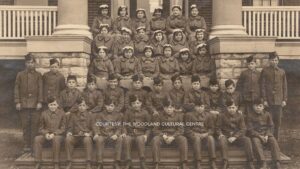 There were stories of boys and girls being segregated and told never to talk to one another. In the case of siblings, they were allowed to speak to one another for 15 minutes once a month. Stories of parents coming to visit and bringing gifts for their children which were quickly confiscated by the staff. Stories from children who managed to hide the little gift somehow and place it in a safe hiding place they discovered under the stairs where they could play with their toys and speak their language. A story from a little boy who never had a visit from his parents.
In many of the rooms, as well as on dining tables and desks in the school room, there were quotes from the students such as, “They have 90 cows here but we see no milk. They have 50 chickens here but we get no eggs. But the staff do.” The children, in fact, were served plain oatmeal, known as mush, with nothing to enhance it, which led to the school being called the Mush Hole. The oatmeal ranged from fresh to rancid, and meals never included milk or eggs, or meat of any kind.
What becomes apparent in the way the authorities within the system are described is one of people being worse than indifferent, with some of them being power-drunk and drunk with power to the point of committing abominations upon children. Such unconscionable behaviour by human beings, many who claimed to be Christian!
The United Nations Convention on the Prevention and Punishment of the Crime of Genocide, defines genocide as “… acts committed with the intent to destroy, in whole or in part, a national, ethnical, racial, or religious group, including forcibly transferring children of the group to another group.” Given this description, the Canadian House of Commons acknowledged that the destruction of Indigenous culture and forced assimilation can constitute genocide under international law.
Those who visited the Woodland Cultural Centre and the Mohawk Institute can’t help but feel deep sorrow, and a desire for healing. We acknowledge the pain and suffering endured by Indigenous children and young people during their time in residential school and seek comfort and healing for all Indigenous peoples affected by this tragic legacy. And that trauma carries on still today in the families of the Residential School survivors.
As the poet Maya Angelou once said, “Once we know better, we must do better” and so we call for a commitment to reconciliation and justice, asking for the Holy Spirit to guide those in their effort to walk the path of truth and love.
by Pastor Mary Dillon